BlogOpen source
We open-sourced a Firecrawl alternative, host it on Vercel, and it was 1.8x faster in our race
webcrawl is an MIT-licensed engine for live web data hosted at webcrawl.app on Vercel Fluid Compute. On 20 public pages it ran 1.8x faster than Firecrawl.
Agents do better with live web access than they do guessing from training data. The catch is cost. Once an agent starts reading docs, repos and product pages in a loop, paid search and scrape APIs add up fast.

We built webcrawl to make that work open. The engine is MIT licensed. The same code powers the webcrawl CLI, the @webcrawl/mcp server, and the hosted API at webcrawl.app, which runs on Vercel. Use the hosted API with 1,000 free credits a month, or self-host the engine if you would rather run it yourself.
#Why did we open-source webcrawl?
We want agents to have a default way to read the public web, the same way they already have a default way to read a file. If the only options are closed APIs with a per-page bill, most agents will keep guessing.
Open source also means you can see how a page became markdown, fix a parser, or add a new target. A change in the repo can ship to both people running it locally and the hosted API.
#How does webcrawl.app run on Vercel?
webcrawl.app is a Next.js app we deploy on Vercel with Fluid Compute. The live site answers with server: Vercel, x-powered-by: Next.js and a Vercel deployment id.
The open-source engine in brainfish-ai/webcrawl-anything does the fetching, parsing and extraction. Fluid Compute gives each request room to fetch and parse concurrently without running our own fleet of scraping workers.
#How did webcrawl.app compare to Firecrawl on 20 pages?
We ran a timed race against Firecrawl's hosted API across the same 20 public pages. Both APIs were called from the same machine against the same URL list, asking each service for clean markdown.
In that run, webcrawl.app finished 1.8x faster than Firecrawl and returned all 20 pages.
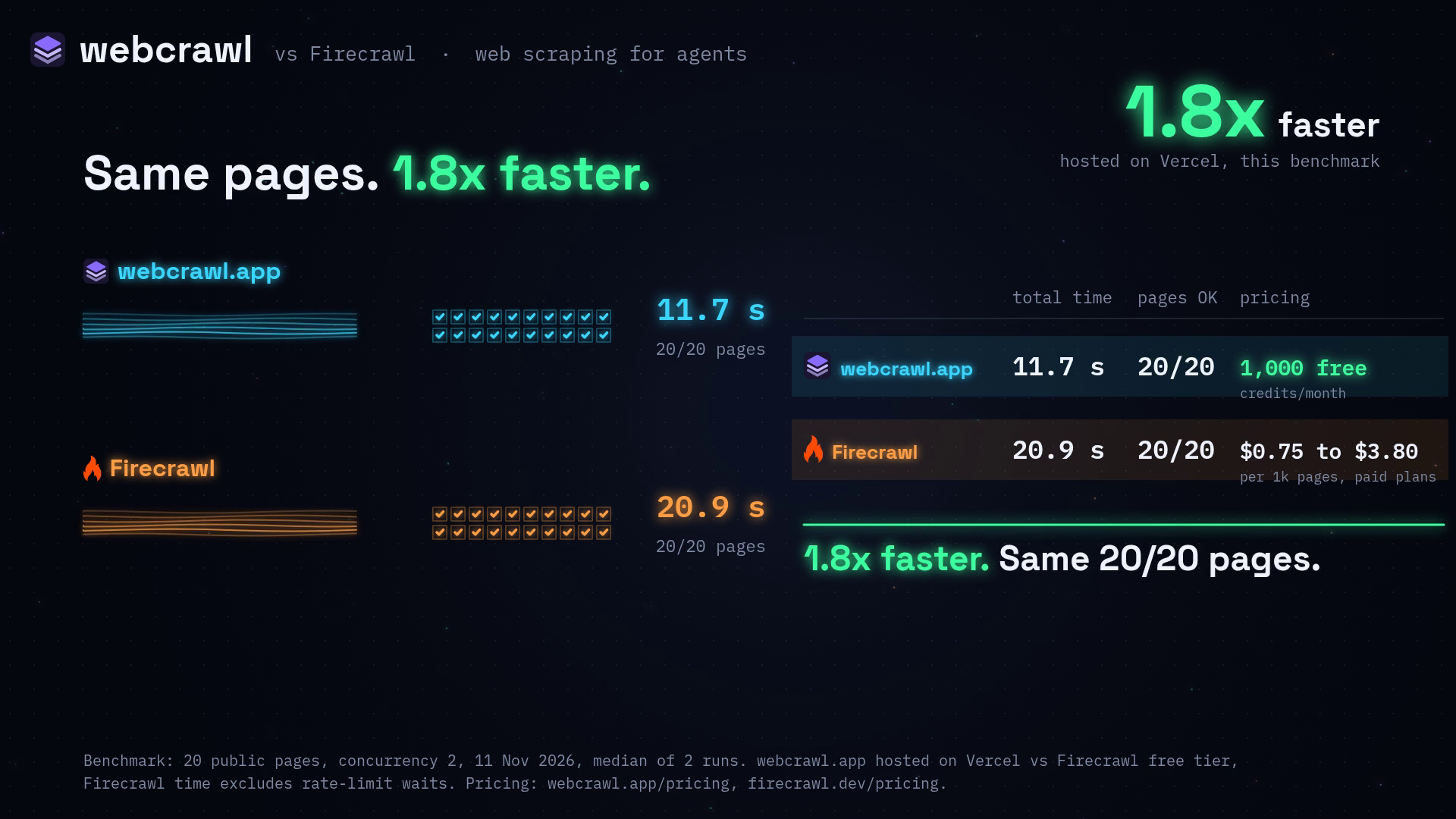
A 20-page sample from one network is a snapshot, not a claim about every site on the internet. Some sites need a real browser, aggressive anti-bot work, or custom extraction rules. The point is that for straightforward public pages, a fast, open HTTP-first engine on Fluid Compute holds up well and stays cheap to run.
#How do you try webcrawl?
The fastest way in is the hosted MCP endpoint. Add https://webcrawl.app/mcp as an MCP server in Claude, Cursor, Codex or another client, or get an API key at webcrawl.app. The free plan is 1,000 credits a month, and it does not need a card. For a sourced head-to-head on license, self-hosting, MCP and pricing, see Webcrawl vs Firecrawl. For a broader shortlist of open source web scraping tools and crawlers, see open source web scraping tools.
To register the MCP server and agent skills for Claude Code, Cursor, Codex and other agents that read SKILL.md:
npx webcrawl setup
Or install the skills directly:
npx skills add brainfish-ai/webcrawl-anything
Because the engine is open source, you can also self-host it from the same npm package.
#FAQ
#What license does webcrawl use compared to Firecrawl?
Webcrawl's core engine, CLI, client, and MCP server are MIT licensed. Firecrawl's core server is AGPL-3.0 while its SDKs and MCP package are MIT.
#Why was webcrawl faster on those 20 public pages?
Webcrawl is HTTP-first and runs concurrently on Vercel Fluid Compute, avoiding headless browser startup overhead on pages that already return full HTML.
#Can I self-host webcrawl on my own server?
Yes. Install webcrawl from npm or deploy brainfish-ai/webcrawl-anything on your own Node.js or Vercel environment.
#Star the repo, and help us build it
If this is useful, star the repo and open a pull request. The contributing guide is a short path for adding a target plugin. We would rather build the default web layer for agents in the open.